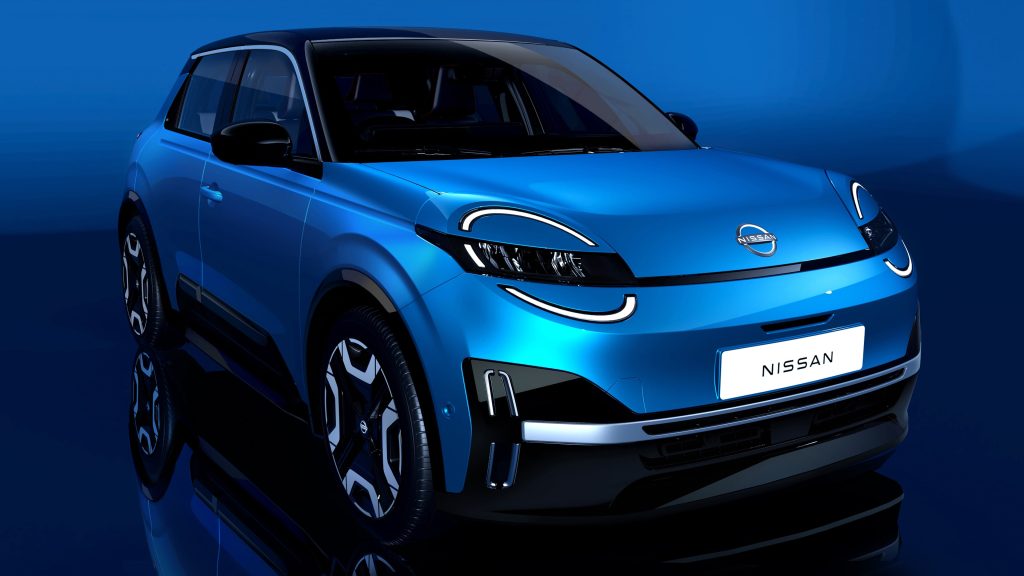
NissanMicra EV
The compact electric hatch that thinks big — 413 km range, ProPILOT tech, and a ride quality that punches well above its class.
A Compact EV That Rivals Higher-End Models
The 2026 Nissan Micra shares its CMF-BEV platform and electrical architecture with the Renault 5 E-Tech, yet Nissan has tuned it distinctly — different drive motor control, Hankook tires, adjusted suspension geometry, and a slightly heavier kerb weight of 1,452 kg. The result is a car with its own personality.
At the end of the 20th century, this sort of performance from a compact hatch would have earned the label “hot hatch.” Today, it simply earns the label well-rounded.
Lively Without Being Aggressive
The Micra’s 0–100 km/h time of 8.0 seconds sits slightly behind the Renault 5 E-Tech’s 7.7 seconds — a gap that is barely perceptible in real driving. In its class, it feels genuinely lively, and you won’t sense any power deficit below 100 km/h.
Torque builds progressively and traction control intervenes gently even under hard acceleration. The Hankook standard tires deliver good grip, though marginally less than the Continental tires on the 5 E-Tech, which can result in earlier understeer at the cornering limit. The stiffer anti-roll bars also contribute to this characteristic.
Braking is strong and capable of smooth, progressive stops. However, the brake pedal has a soft feel that makes it harder to gauge friction brake engagement through the pedal. Adjustable regenerative braking via steering-wheel paddles is a welcome addition.
Ride Quality That Rivals a Class Above
The ride is one of the Micra’s standout achievements. It absorbs road imperfections with a composure that feels distinctly premium for a subcompact. The chassis is tuned marginally firmer than the 5 E-Tech, which benefits body control and steering feel — the wheel responds with a pleasing weight and precision.
Rear passenger space is the main limitation: the back seats feel narrow, reflecting the constraints of the compact footprint. Beyond this, the interior quality and control consistency make the Micra feel intuitive from the first drive.
Advanced Driver Assistance & ProPILOT
Nissan’s top-of-the-range ProPILOT system is impressively comprehensive. Mid-range and higher trims include adaptive cruise control, blind-spot monitoring, lane-keeping assist, collision mitigation braking, and speed limit recognition. The driver monitoring system is present but occasionally over-sensitive.
Top-spec Evolve trim adds highway-capable semi-autonomous driving through ProPILOT, which handles surrounding traffic with composure. Overall, the system rarely intrudes unnecessarily — a strong differentiator in this segment.
413 km WLTP — Competitive Real-World Numbers
The Micra’s 52 kWh battery edges ahead of the Renault 5 E-Tech on range. Real-world testing shows approximately 280 km at sustained highway speeds and up to 390 km in urban environments where regenerative braking maximises efficiency at 6.7 km/kWh.
DC fast charging at up to 100 kW means topping up from 20% to 80% takes around 30 minutes at a compatible charger — practical for occasional long trips. Rivals from Hyundai, Citroën, and Fiat are priced lower, but their range figures don’t match the Micra.
Value for Money in the EV Market
In the UK, the 2026 Nissan Micra starts at £21,495 after applicable government EV subsidies — broadly comparable to the Renault 5 E-Tech. In the US, pricing is estimated at $26,000–$28,000 USD, pending official confirmation.
While budget-segment rivals undercut it on sticker price, the Micra justifies its position through superior range, a more sophisticated ride, and comprehensive driver assistance as standard on higher trims.
Pros & Cons
Pros
- Longer real-world range than Renault 5 E-Tech
- Smooth, predictable power delivery
- Ride quality rivals larger, more expensive cars
- Well-balanced handling for a compact
- ProPILOT semi-autonomous system is class-leading
- Practical for both city and highway driving
Cons
- Slightly less corner grip vs Continental-shod rivals
- Rear seats are notably narrow
- Less distinctive styling than the Renault 5
- Soft brake pedal feel lacks tactile feedback
- Nissan character could be more pronounced
2026 Nissan Micra 52kWh — Full Specs
| Price (UK) | From £21,495 |
| Est. Price (US) | ~$26,000–$28,000 USD |
| Battery Capacity | 52.0 kWh |
| Power Output | 150 PS |
| Torque | 245 Nm (24.9 kg-m) |
| 0–100 km/h | 8.0 seconds |
| Top Speed | 149 km/h |
| WLTP Range | 413 km |
| Efficiency | 6.7 km/kWh |
| Fast Charging | 100 kW (DC) |
| Drive | Front-Wheel Drive |
| Motor Type | Externally Excited Synchronous |
| Kerb Weight | 1,452 kg |
| Length | 3,950 mm |
| Width | 1,780 mm |
| Height | 1,499 mm |
| Standard Tyres | Hankook |
Frequently Asked Questions
Yes. The 2026 Nissan Micra EV offers a compelling blend of performance, comfort, long-range capability, and advanced driver assistance, making it one of the most well-rounded compact electric cars available in 2026.
The WLTP-certified range is 413 km. In real-world driving, expect around 280 km at sustained motorway speeds and up to 390 km for everyday city use where regenerative braking helps recover energy.
It accelerates from 0 to 100 km/h in 8.0 seconds with a top speed of 149 km/h. While not the quickest in class, it feels lively and responsive in everyday driving up to motorway speeds.
The Micra has a slightly longer real-world range and firmer ride with tighter body control. The Renault 5 E-Tech has a marginally better comfort-to-handling balance and more grip from its Continental tires. Pricing is comparable in the UK.
Yes. The Micra supports DC fast charging at up to 100 kW, enabling a 20–80% charge in approximately 30 minutes at a compatible rapid charger.
The 2026 Nissan Micra EV starts from £21,495 in the UK after government EV subsidies. The estimated US price is $26,000–$28,000 USD, though this has not been officially confirmed for the American market.
Absolutely. Its compact 3,950 mm length, smooth power delivery, excellent urban range of up to 390 km, and intuitive controls make it an ideal choice for city commuting and everyday errands.